
Marketing Funnel Explained: A Simple Guide for Beginners
Consumers are a crucial part of any business. That’s why it’s important to understand how people discover and engage with your brand.
Let’s be real: having a great product is only half the battle.
The real challenge? Getting someone who has never heard of you to actually pull out their credit card. That’s where the marketing funnel comes in.
For digital marketers (including SEO specialists), understanding the marketing funnel is essential. It helps us create more effective and relevant content strategies for our potential customers.
In this article, we’ll explore everything you need to know about the marketing funnel – its definition, benefits, models, stages, and the strategies that work at each stage.
So, without any further ado, let’s dive in!
What is a Marketing Funnel?
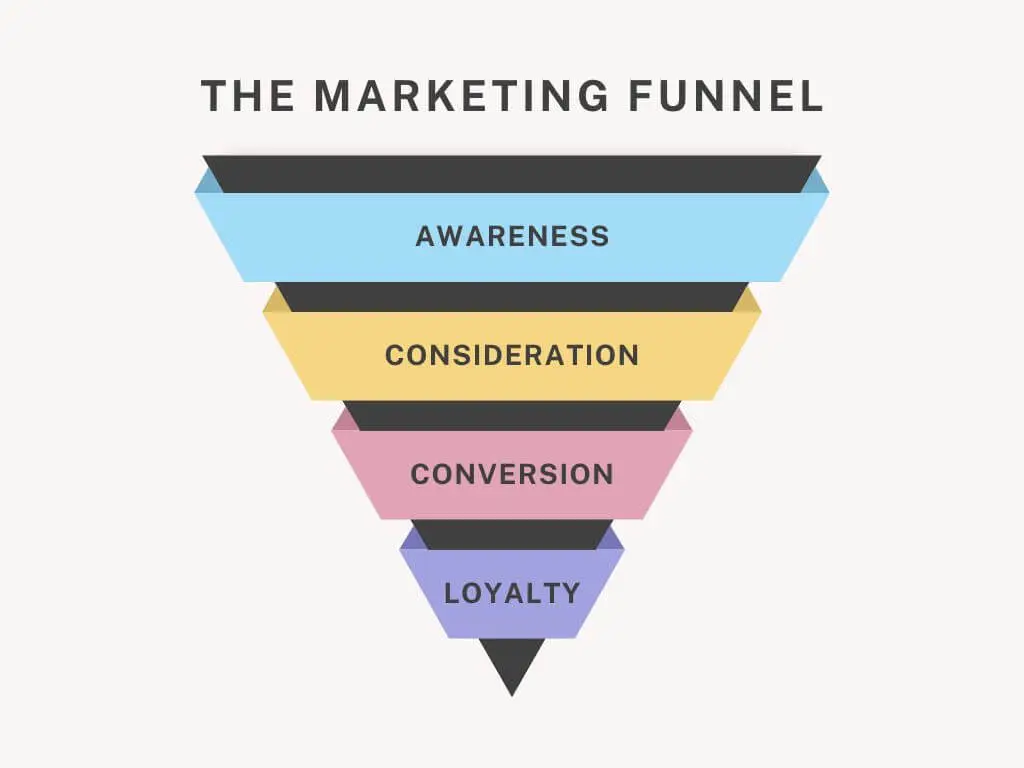
The marketing funnel is a concept that illustrates the customer journey from awareness to loyalty, from first learning about your brand or product to ultimately making a purchase.
There are plenty of models out there, from AIDA to TOFU-MOFU-BOFU. Whatever the model, the goal remains the same.
The journey is visualized as a funnel, reflecting how audiences narrow at each stage. Not everyone who becomes aware of your brand will convert, so only a portion progress further as potential customers.
The Benefits of Marketing Funnel
The marketing funnel mattersbecause it simplifies the customer journey and makes it easier to understand and manage. In reality, however, the process isn’t always linear – people often move back and forth between stages.
Even so, the funnel provides a clear mental model that helps you optimize your strategy at each stage.
It can be applied across many business contexts – whether your goal is driving online sales, generating traffic or leads, or increasing visits to a brick-and-mortar store. The funnel helps you plan the right strategy for each objective.
It also helps set realistic expectations for your marketing efforts, making it easier to measure performance and evaluate results.
Marketing Funnel Models
Here are several widely adopted marketing funnel models that help digital marketers structure customer acquisition and conversion:
1. AIDA Model
The AIDA model is one of the earliest and most widely recognized marketing funnel models, introduced by E. St. Elmo Lewis.
It outlines the psychological stages a prospect goes through before making a purchase decision. AIDA stands for:
- Awareness – the audience becomes aware of a brand, product, or solution. The objective here is visibility and attention.
- Interest – once aware, prospects begin exploring further. The focus shifts to relevance and education.
- Desire – interest evolves into preference and emotional inclination. This stage emphasizes value proposition, differentiation, and trust.
- Action – the prospect takes a measurable step like purchase, sign-up, demo request, etc. The priority is minimizing friction and presenting a clear call-to-action.
2. TOFU-MOFU-BOFU Model
The TOFU–MOFU–BOFU model is a marketing funnel model widely used in digital and inbound marketing.
Instead of focusing purely on psychology, it segments prospects based on buying readiness. Here’s the brief explanation:
- TOFU (Top of Funnel) – this is the awareness stage. The audience is discovering their problem or learning about possible solutions.
- MOFU (Middle of Funnel) – this is the consideration stage. In this stage, potential customers are evaluating different solutions or providers.
- BOFU (Bottom of Funnel) – the decision stage when potential customers are ready to choose a solution.
Marketing Funnel Strategies at Each Stage
Understanding the funnel is one thing, but actually driving people through it? That’s where the magic (and the hard work) happens.
Using the classic AIDA model, let’s break down exactly how to treat your audience at every step so they don’t just “visit,” but actually “convert.”
1. Awareness
Your audience has a problem, and they’re Googling for answers. Your job here is to be the most helpful person in the room. Don’t talk about your product yet – talk about their pain points.
You have to capture informational content through high-value blog posts, “How-to” YouTube videos, and educational social media threads.
2. Interest
Audiences have already read your blog, and they’re starting to consider your brand as a potential solution. This is the “Middle of the Funnel” (MOFU). You need to move them from “just browsing” to “staying in touch.”
This is the land of the Lead Magnet. Offer a free checklist, a mini-ebook, or a webinar. You want their email address so you can start talking to them directly.
3. Desire
Logic gets people interested, but emotion and trust make them buy. At this stage, your leads are comparing your brand to your competitors.
You need to prove that your solution isn’t just “good,” it’s the only one that makes sense for them.
Social proof is your weapon here. Case studies, video testimonials, and deep-dive product comparisons.
You can also use Retargeting Ads (Facebook/Google) to show a testimonial to someone who just visited your “Interest” page.
4. Action
The Bottom of the Funnel (BOFU). They are standing at the finish line, holding their credit card. Don’t let a slow website or a confusing checkout form ruin the relationship at the last second.
Use clear, high-contrast CTAs, limited-time discounts (FOMO), or a dead-simple checkout process.
If you’re a service-based business, this is where the “Book a Discovery Call” button needs to be unmissable.
Key Takeaways
The best product won’t sell itself. You need a clear strategy that guides your audience every step of the way.
The marketing funnel is more than just a framework – it’s a practical way to understand how people move from discovering your brand to becoming paying customers.
By aligning your content, messaging, and strategy with where your audience is in their journey, you make it easier for them to move forward with confidence.
When done right, the marketing funnel doesn’t just improve conversions – it creates a smoother, more meaningful experience that turns curious visitors into loyal customers.
Frequently Asked Questions (FAQ)
What is a marketing funnel?
A marketing funnel is a framework that maps the customer journey from first discovery of a brand to purchase and loyalty.
Why is the marketing funnel important for digital marketing?
It helps marketers understand customer behavior, deliver relevant content at each stage, improve conversions, and measure campaign performance more effectively.
What are the main stages of a marketing funnel?
Most funnels follow four core stages: Awareness, Interest, Desire (or Consideration), and Action (Conversion).
Why is a marketing funnel important for SEO specialists?
For SEO specialists, the funnel helps in creating a comprehensive keyword strategy. It ensures you aren’t just targeting “buy” keywords, but also capturing “how-to” informational traffic at the top of the funnel to build trust and authority early in the user’s journey.
How do you create content for each marketing funnel stage?
Use educational content for awareness, lead magnets for interest, social proof and comparisons for desire, and strong CTAs or seamless checkout for action.

